
Simple Interest vs Compound Interest: Complete Guide with Formulas & Examples
Learn the difference between simple and compound interest with formulas, examples, comparison tables, FAQs, and free calculators. Calculate SI & CI instantly.

Introduction
Simple interest and compound interest are two methods of calculating interest on money whether you’re borrowing a loan or growing your savings. Understanding the difference is essential for students studying mathematics or commerce, professionals comparing loan offers, and anyone making financial decisions.
This guide explains both types with clear formulas, worked examples, and a side-by-side comparison to help you pick the right calculator for your needs.
What Is Simple Interest (SI) ?
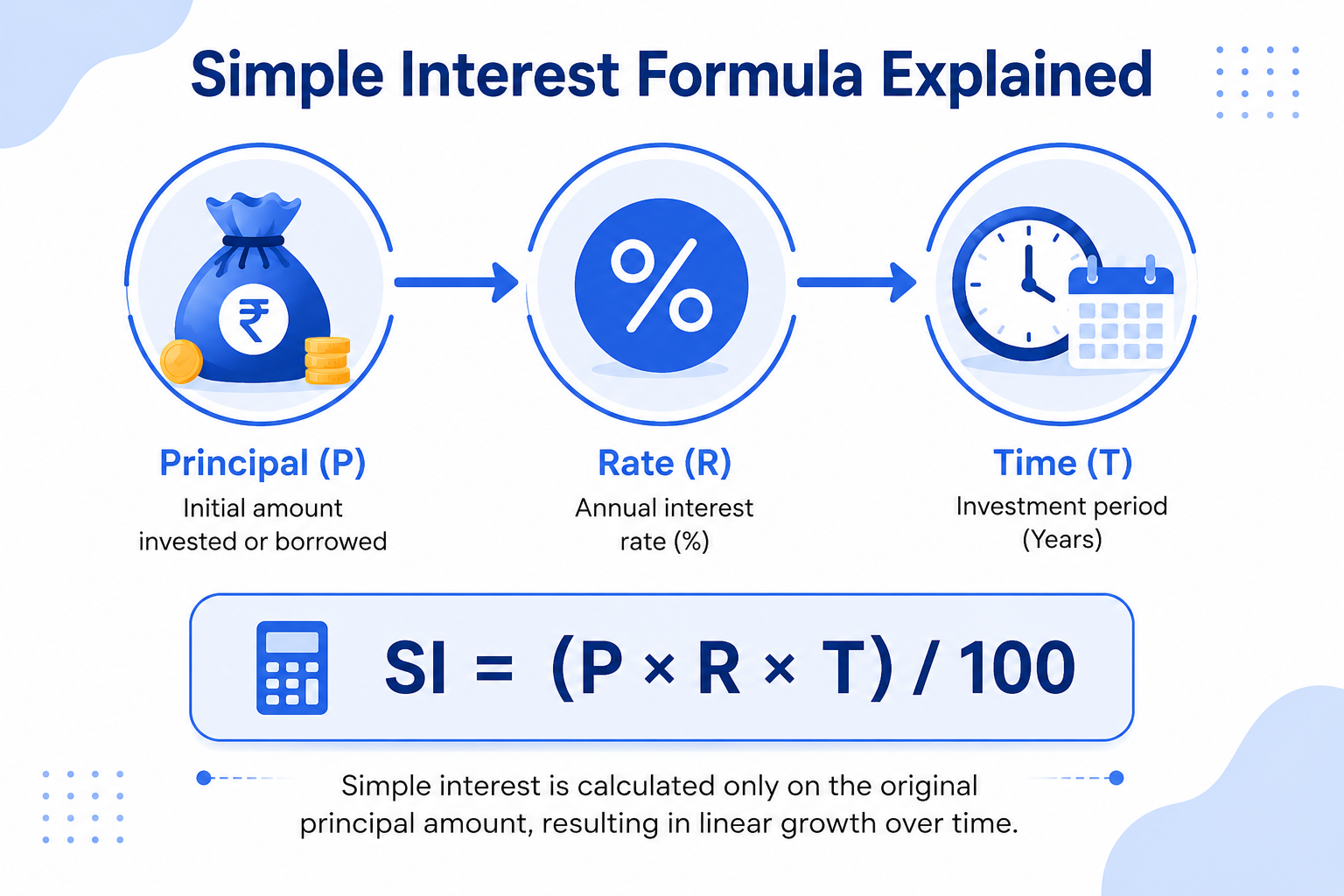
Simple interest is calculated only on the original principal amount. The interest stays the same every year, no matter how long the money is invested or borrowed.
Formula :
SI = (P × R × T) / 100
| Symbol | Meaning |
|--------|------------------------------|
| P |Principal (initial amount in ₹) |
| R | Rate of interest per annum (%) |
| T | Time period (in years) |
Total Amount = P + SI
Worked Example : 1
₹50,000 at 8% for 3 years
SI = (50,000 × 8 × 3) / 100 = ₹12,000
Total Amount = 50,000 + 12,000 = ₹62,000
Worked Example : 2
₹1,00,000 at 10% for 6 months (T = 6/12 = 0.5 years)
SI = (1,00,000 × 10 × 0.5) / 100 = ₹5,000
Key Characteristics of Simple Interest
- Interest amount is constant every year
- Growth is linear (a straight line on a graph)
- Common in short-term loans, some fixed deposits, and exam problems
- Easy to calculate manually
What Is Compound Interest (CI) ?
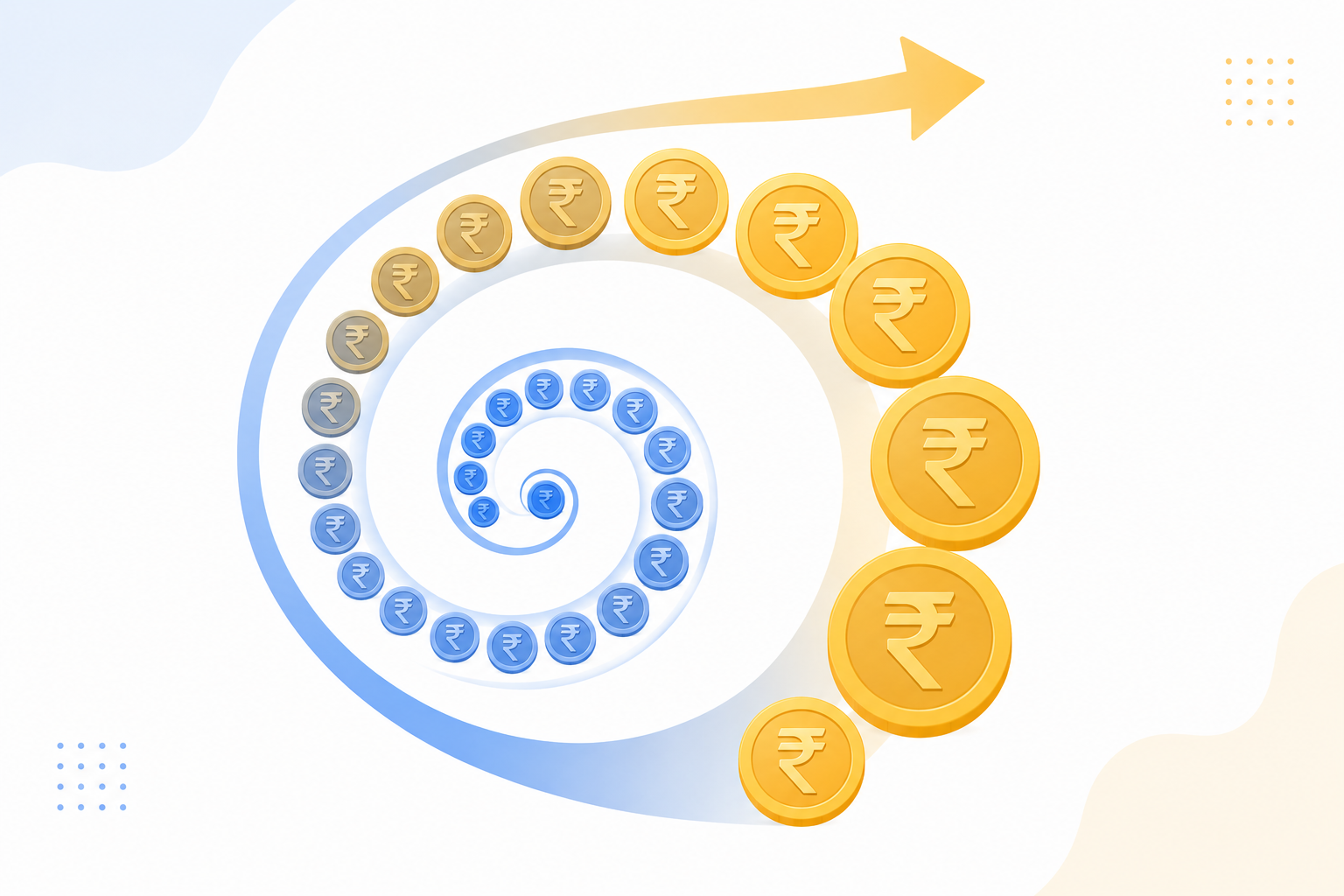
Compound interest is calculated on the principal plus previously accumulated interest. In other words, interest earns interest this is the “compounding” effect.
Formula :
A = P × (1 + r/n)^(n×t)
CI = A − P
| Symbol | Meaning |
|--------|---------|
| A | Final amount |
| P | Principal |
| r | Annual interest rate (decimal, e.g. 10% = 0.10) |
| n | Number of times interest compounds per year |
| t | Time in years |
Compounding Frequencies :
| Frequency | n value |
|-----------|---------|
| Annually | 1 |
| Half-yearly | 2 |
| Quarterly | 4 |
| Monthly | 12 |
| Daily | 365 |
Worked Example : 1
₹1,00,000 at 10% compounded annually for 3 years
A = 1,00,000 × (1 + 0.10/1)^(1×3)
A = 1,00,000 × (1.10)³
A = 1,00,000 × 1.331 = ₹1,33,100
CI = 1,33,100 − 1,00,000 = ₹33,100
Compare: Simple interest for the same terms would be ₹30,000 compounding earns ₹3,100 more.
Worked Example : 2
₹2,00,000 at 12% compounded quarterly for 2 years (r = 0.12, n = 4, t = 2)
A = 2,00,000 × (1 + 0.12/4)^(4×2)
A = 2,00,000 × (1.03)⁸
A = 2,00,000 × 1.2668 = ₹2,53,360
CI = ₹53,360
Side-by-Side Comparison :
| Feature | Simple Interest | Compound Interest |
|---------|-----------------|---------------------|
| Calculated on | Principal only | Principal + accumulated interest |
| Growth pattern | Linear | Exponential |
| Formula | P×R×T/100 | P(1+r/n)^(nt) − P |
| Better for borrower | Lower cost for short terms | Higher cost over long terms |
| Better for investor | Gives lower returns | Gives higher returns |
| Common usage | Short-term loans, simple FDs | Savings accounts, mutual funds, long-term loans |
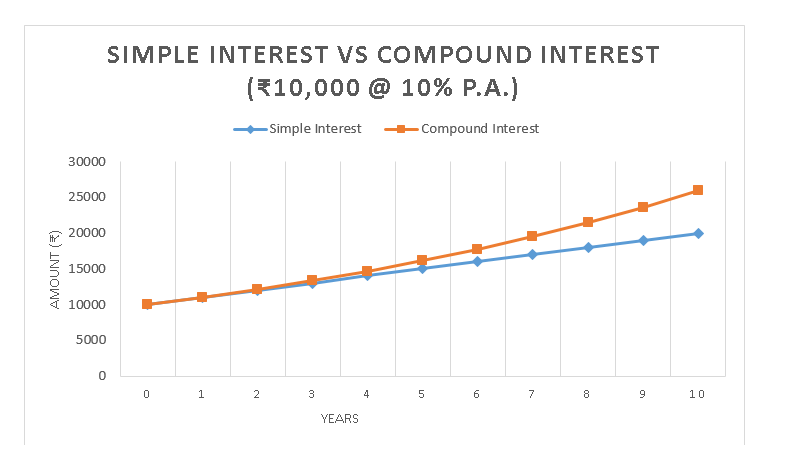
Year-by-Year Comparison: ₹10,000 at 10%
| Year | SI Interest (Total) | CI Interest (Total) | Difference |
|------|----------------------|------------------------|------------|
| 1 | ₹1,000 | ₹1,000 | ₹0 |
| 2 | ₹2,000 | ₹2,100 | ₹100 |
| 3 | ₹3,000 | ₹3,310 | ₹310 |
| 5 | ₹5,000 | ₹6,105 | ₹1,105 |
| 10 | ₹10,000 | ₹15,937 | ₹5,937 |
- Takeaway: The longer the duration, the greater the advantage of compound interest for investors and the greater the cost for borrowers.
When Should You Use Which ?
- Use Simple Interest when:
- Calculating short-term loan payments
- Solving school or college math problems
- Making quick mental estimates
- Use Compound Interest when:
- Comparing bank FD or savings account returns
- Planning mutual fund or SIP growth
- Calculating long-term loan costs (EMI uses compound interest)
- Projecting retirement savings
Try It Online Tools :
- Simple Interest Calculator - instant SI calculation with formula display.
- Compound Interest Calculator -supports multiple compounding frequencies with a year-by-year table.
NOTE : Both tools on Numverto are free, show step-by-step working, and use Indian rupee formatting.
Frequently Asked Questions ?
Which gives more return simple or compound interest ?
Compound interest always gives more return than simple interest for the same rate and duration (beyond year 1), because you earn interest on accumulated interest.
Do Indian banks use simple or compound interest ?
Most Indian banks use compound interest for savings accounts (quarterly compounding) and loans (monthly compounding via EMI). Simple interest is rarely used except in some short-term instruments.
What happens if compounding frequency increases ?
More frequent compounding (monthly vs yearly) yields slightly higher returns because interest is added to the principal more often. The difference is small for short periods but significant over many years.
Is EMI based on simple or compound interest ?
EMI uses compound interest with monthly compounding (reducing balance method). Each month, interest is calculated on the remaining outstanding principal, not the original loan amount.
How do I calculate CI for half-yearly compounding?
Use n = 2 in the formula. For ₹1 lakh at 10% for 1 year compounded half-yearly:
A = 1,00,000 × (1 + 0.05)² = 1,00,000 × 1.1025 = ₹1,10,250
CI = ₹10,250 (vs ₹10,000 with annual compounding)
Free tools
Learn faster with Numverto
Free number system converters, binary tools, EMI calculators, and more, with step-by-step working.
Written by

Mannu Kumar
Founder of Numverto. MCA graduate, full-stack developer, and lifelong learner who built this platform so every student gets the explanation, not just the answer.
Related tools
More from Numverto Blog
finance
Home Loan Eligibility Calculator — How Banks Decide Your Loan Amount in India
Learn how Indian banks calculate home loan eligibility based on salary, age, and CIBIL score. Includes eligibility formula, worked examples, and tips to increase loan amount.
30 June 2026
finance
PPF Calculator — Public Provident Fund Returns Explained with Examples
Learn how PPF interest is calculated in India. Includes year-wise growth table, PPF vs FD vs SIP comparison, tax benefits, and free PPF calculator.
30 June 2026
Discussion